
Walking and Walkers
How modern life turns verbs into nouns.

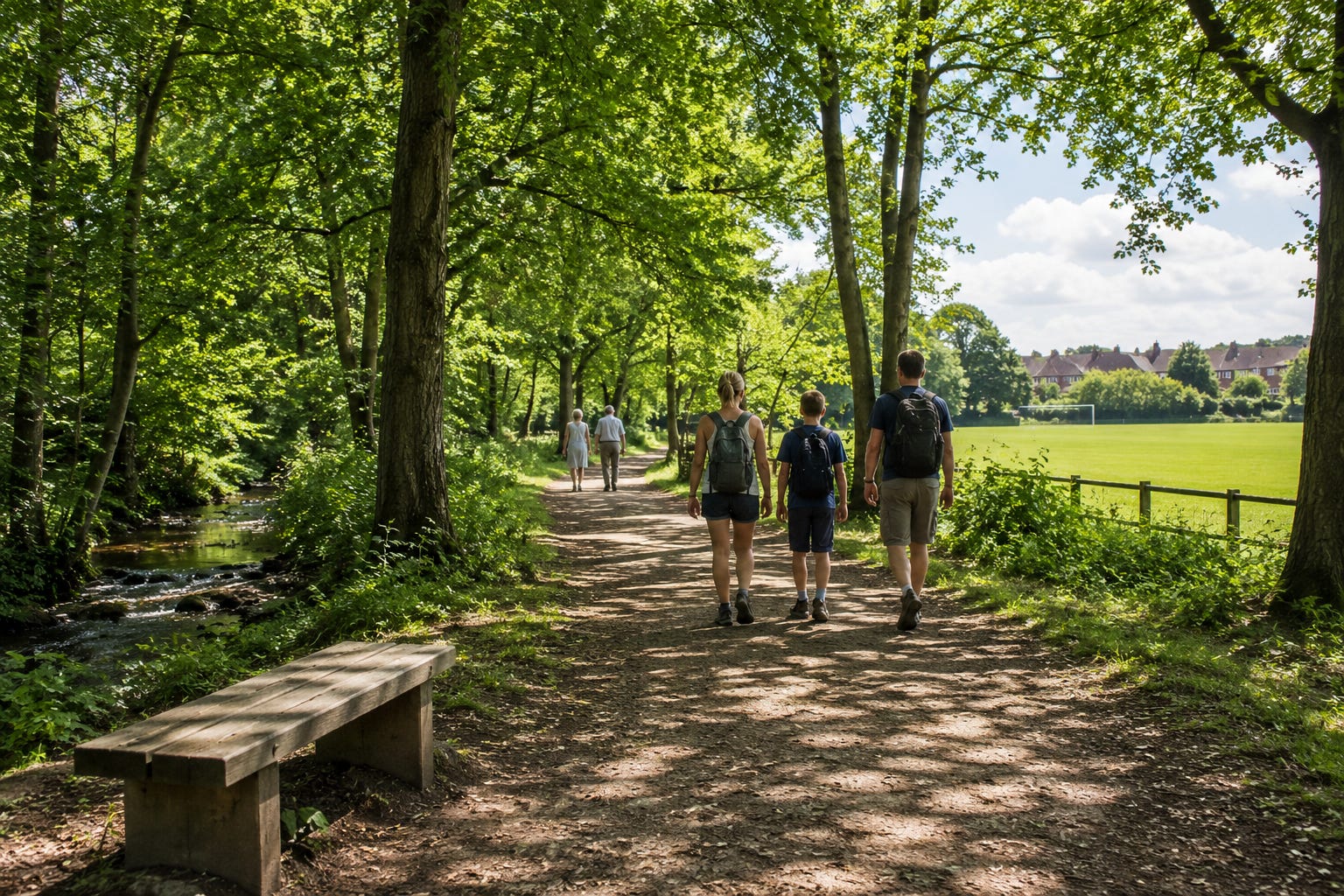
Buddha, they say, achieved Enlightenment under the Bodhi tree. I was in a wood. There were trees around. One had fallen, creating a bench conveniently at bum height. The sun dappled through the canopy. A stream burbled contentedly in the background. I sat down. Maybe lightning could strike twice.
It didn’t. Perhaps oaks don’t have the same spiritual properties as bodhi trees. Perhaps it was the insects, flying around like fans whose team has just won the championship. That I am not an obvious candidate for Enlightenment is not, I think, an explanation on which we need to linger.
But between Nirvana and normal life, there are different levels. It was nice in the woods. Cool on a hot day. The birds were singing. The trees were emitting those tree smells science now thinks good for us. I took occasional swigs from the old tonic bottle I’d refilled before leaving, enjoying my free wellness retreat.
A family passed. Mum, Dad and son, the latter approaching that age at which he will refuse to be seen with his parents. The males wore shorts and tee-shirts, the mother, shorts and a vest. The adults wore backpacks. Possibly a CamelBak in Mum’s case. All carried water bottles (the type pro-cyclists give to fans on the road-side) and wore walking shoes. They were ready.
For what, though, I wasn’t entirely sure. Sitting in a suburban wood, I was reasonably confident they weren’t doing the Marathon des Sables. Twenty yards behind them, I could see the freshly mown grass of the municipal football pitch. Morrisons was a ten minute walk away if they put their minds to it, Sainsbury’s fifteen. And there was a pub on the way. This particular rus was very much in urbe.
They weren’t the only people in the woods that day. I’d passed a couple on the way to the date at which Enlightenment had ghosted me. She was wearing a summer dress and sandals, he a pair of trousers and a shirt. They seemed perfectly happy. Side by side, maybe hand in hand, I can’t remember. No limping from blisters. No obvious signs of chafing. Nor any of dehydration. Just two people out for a walk on a sunny day.
Marginal gains do have their place. If you’re trying to win the Tour de France. Sleeping on your own mattress will help you recover, making you fresher when you have to climb Alpe d’Huez. But we were not facing that sort of parcours. In metres, our elevation gain across the stage could be counted without removing one’s (ankle) socks. Age aside, there was no reason to believe the family would out-perform the couple.
And yet, they had gone to the effort of putting on their specialised kit. Why? What made it worth the time?
Perhaps there was an element of display. People who wear specialised clothes are people who can afford specialised clothes. Look back at the photos from the early days of mass leisure and you’ll be surprised at the number of men wearing suits. That was the clothing they had, so that was the clothing they wore. Even on the beach. By wearing walking shoes, the family were telling those they met that they could afford shoes just for that particular activity.
Perhaps their outfits were markers of belonging. They were Walkers.
If they were, I couldn’t really hold that against them. In my late youth, I would rise on a Saturday, put on my jodhpurs and boots and head off for the tube. Look at me, my outfit proclaimed as I strode along the platform like a 19th century bounder, I am a Rider.
Jodhpurs, though, are functional in a way that walking shoes in a suburban wood are not. I learned early on in my riding career that the skin of the inner thigh is unexpectedly tender. And the seam of a pair of jeans is ideally placed to prove this when pressed against a horse’s rib-cage. But I didn’t have to wear them in Fulham Broadway. That was a choice.
A choice I think the family was also making. To turn an activity into an identity. A verb into a noun.
Humans have long used clothing to send messages. The thickness (or indeed the absence) of the purple stripe on a toga immediately told other Romans the wearer’s social class. Uniforms revealed regiments, ties, schools and colleges. They were a way of saying, “This is what I am”.
That we no longer wish to define ourselves in these terms, many of which were chosen for us rather than by us, does not mean we no longer wish to define ourselves. In an individualistic society, what we do can easily become what we are. And what we want others to think we are. Our tribes are less those of shared ancestry, and increasingly those of shared interests. If you meet someone new, you’ll probably tell them what your job is and how you spend your free time. You are not you - you are a banker who does yoga, or a teacher who wild-swims. Not a person, just a page in a diary.
But if we need to perform our identity, then our identities can easily become a performance. A Walker has to look like a Walker and they have to walk well. A Walker is not a casual stroller. Anyone can do that. A Walker takes walking seriously. Has the right kit. Plans a route. Gathers data. Maybe puts it in a spreadsheet.
The couple I saw seemed to be enjoying themselves. They were strolling along, enjoying the weather and the scenery. The family I was less sure about. There seemed to be a purpose to their walking, less ambling, more like getting from station to office. They didn’t stop to look at their surroundings, they just kept marching on, line astern. It seemed a mission to be completed, not an experience to be enjoyed.
Maybe it had to be. Anyone can wander through the woods, stop by the stream, listen to the bird-song. And nobody wants to be just anybody.
If Enlightenment hadn’t come before I saw them, it certainly wouldn’t after. I left a while for them to pass and started to meander back home. Never saw them again. Of course, I didn’t. I was in shirt, trousers and boat shoes. I had no chance.
I logged on to Facebook when I got back. It showed me a quote attributed to William Faulkner, “Don’t be a writer. Be writing.” Maybe my walk had been more spiritual than I thought.