
Slave to our Stats
On streaks, statistics and the Protestant Play Ethic

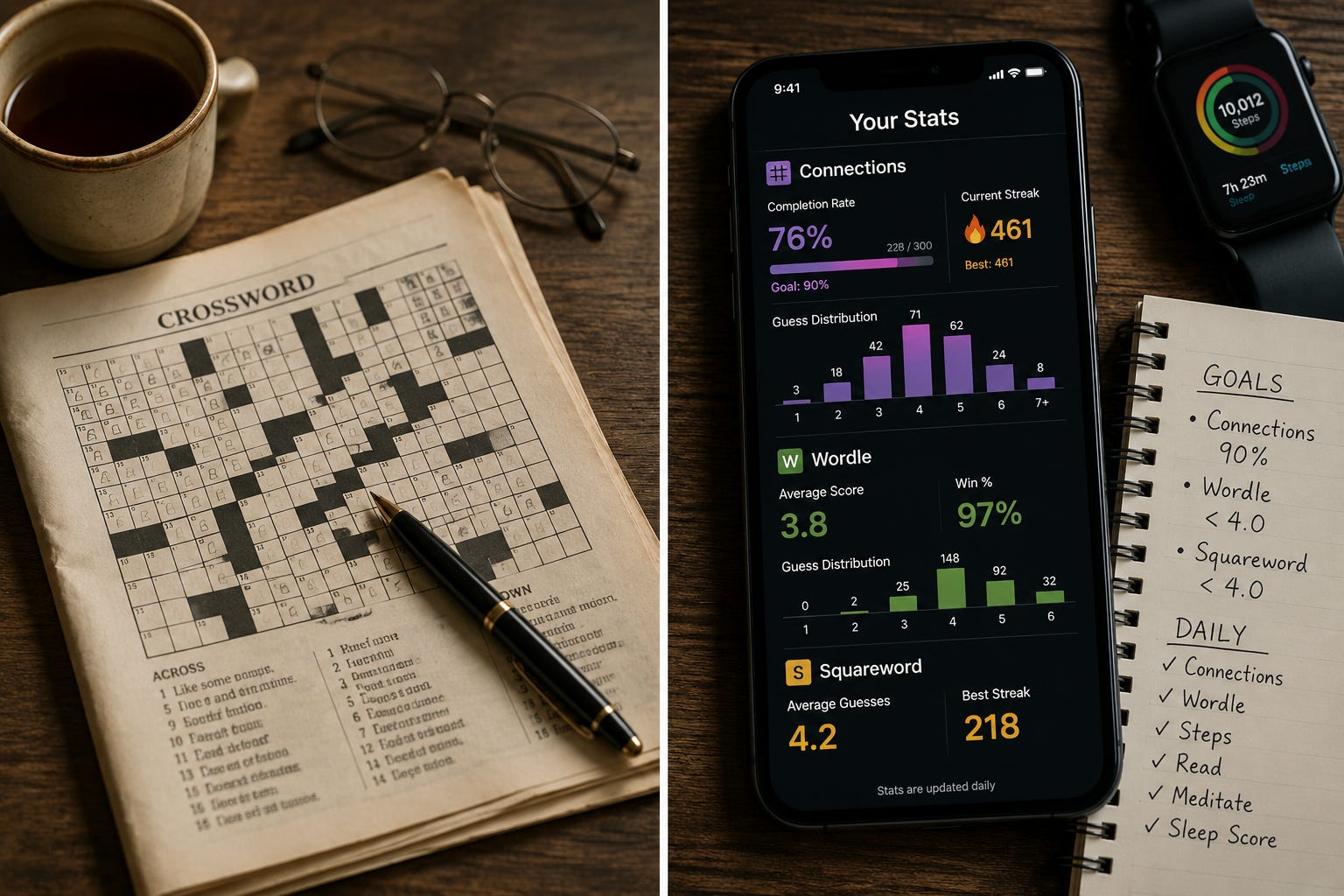
The thoughts we can think depend, to an extent, on when we think them. The invention of football being several hundred years in the future, no Roman could speculate on the winner of the World Cup.
“I’d like to get that up to 90%,” struck me as being similar when it flicked through my mind the other day.
“That” in question was my completion rate for The New York Times’ “Connections” puzzle and I found it hard to imagine that my grandfather or anyone earlier could ever have thought anything like it.
Not only does the game post-date him (and the NYT was not widely available in the West of Scotland in his day) but if he did a puzzle, he would have done it in a totally different way to his grandson. He would have sat at a table, taken out a pen and started filling it in.
He may have had some sort of inkling about how good he was at, for example, crosswords, but he almost certainly didn’t have any data. When the calendar flipped over to the next day, the paper would have been thrown away. Or maybe used to light the fire. There was no ongoing collection of statistics.
His grandson, by contrast, knows not only just how often he completes “Connections”, he knows the distribution of the number of attempts he takes to solve “Wordle” and the average number of goes he takes to finish “SquareWord” - both month-to date and since inception.
When we have a measure, we often turn it into a target. Knowing how good we are often makes us want to get better. There are benefits to this - trying to lower your 5k time will make you fitter. But applied too widely, problems start to emerge - by setting a target for “Connections”, I have turned it from play into another domain in which I perform.
And “Connections” is not necessarily as amenable to improvements as running. Presented with a grid of sixteen words, the aim is to form them into groups of four which share a link. Maybe the connection is words which contain another within them, maybe they can be turned into another by adding a letter. They might be the names of baseball teams. They might be types of pie.
I recently discovered that “chess” is an acceptable answer to the latter. Who knew? As a Brit, I certainly didn’t. As an American, perhaps I would. Every time I play, therefore, I roll the dice that my knowledge of the States is up to that expected by the setter. Sometimes it is, sometimes it isn’t. And there is nothing I can really do about this. Except moving across the Pond. Which seems a little over the top.
Setting a target which I need luck to hit raises the prospect that I will fail. And the rise of data in our everyday lives has increased the number of domains in which failure is now an option. My grandfather would have known how he performed at work. He would have known where he ranked in the bowling league. But he would have no idea how far he had walked in any day - you may know by just how many steps you’ve missed your 10,000. He might have had a bad night - you have failed to get enough R.E.M. sleep. The more data seep into our previously unquantifiable safe spaces, the more unflinching reminders we get of how far we have fallen short.
And it is generally we who have failed. We tend to over-estimate our agency and blame ourselves rather than misfortune when things go wrong, turning things which could make us feel good into reasons to feel bad.
Nowhere is this more obvious than in the “streak”. Doing cross-words may, or may not, have been a habit for my grandfather, but that is all that it was. If he missed a day, he missed a day. If I don’t solve Squareword tomorrow, my 461-day streak comes to an end. I will experience a loss which he never did.
For while our streaks may be in trivial domains, they are not, in themselves, trivial. They tell us that we are consistent. And that we are conscientious. Both good qualities. They are evidence that we are who we would like to be. And would like others to think we are (Duolingo streaks are, I have noticed, particularly prone to being shared…). Losing them creates problems for our self-image in a way that the paper-boy not coming one day would not have for my grandfather. Problems that increase the longer the streak lasts - anyone can do 20 days, only the truly virtuous manage 200. Thus we persist on the treadmill of “fun”, having invented the Protestant Play Ethic.
“We must imagine Sisyphus happy,” wrote Camus. Perhaps turning leisure into a Sisyphean task helps to explain why we are unhappy. Every day, we have to return to the hill to keep our streak going. And at some point, the stone will roll back down the hill again (there are, for example, some four-letter groups which can be turned into more five-letter words than Wordle allows you to try). There is little play here, only a certain grim determination, and the knowledge of eventual failure, each loss taking us further away from the Promised Land of our target. We have to keep running just to stay still. Whether we enjoy it or not.
Sisyphus, Camus thought, was happy because he recognised the absurdity of his situation. Perhaps that is the way forward. There is a certain absurdity about investing too heavily in how many days in a row we have done a particular puzzle, how often we have solved it, or how many pages we have read. They are the product of multiple factors beyond our control. The amount they actually tell us about ourselves is minimal - no matter how long your Wordle streak, if you keep bunking off work, you’re not conscientious. They are things we do, not what we are.
Wisdom, many traditions say, lies in treating things appropriately. That may be what we have lost. We have not put our childish things away, but started to treat them with our adult tools. A child does not define itself through its ability to play Snakes and Ladders or to do so day after day. It might get upset if it loses. But then it just starts again. Because it wants to play, not to be a player or consistent or dedicated or anything else. And that is enough. That is where the fun lies.
Connections is just a game. I’ll play it again tomorrow. I have to. Maybe some day I’ll play it because I want to.