
Rowing Back to the Past
Why the books we love are so often the books we read at school.

We recently discussed The Guardian’s list of the 100 Best Novels. Now, with the concern for democracy one might expect from the country’s premier left-leaning newspaper, they are back, publishing a list of their readers’ 100 Best Novels.
Unsurprisingly, The Guardian’s readers have produced the sort of list one might expect Guardian readers to produce. The Handmaid’s tale makes the list as does Wolf Hall. Dickens’ concern for social justice is praised. One might, if so minded, raise half an eyebrow at the under-representation of foreign fiction from a group who would probably identify as internationalist - East Asia hardly appears. There is no Naipaul or Zweig or Calvino.
My own choice, I think, would be one of Middlemarch or War and Peace. Not that I’ve actually read either of them, but people who know about these things usually pick them and who am I to disagree?
If we narrow the list to books I have finished, The Count of Monte Cristo is tempting, but the plot holes probably rule it out (a man thrown into the sea in a weighted body bag is able to escape and swim for several miles after years of starvation rations. Really?). So we’d probably end up with The Great Gatsby. A safe choice, it came sixteenth.
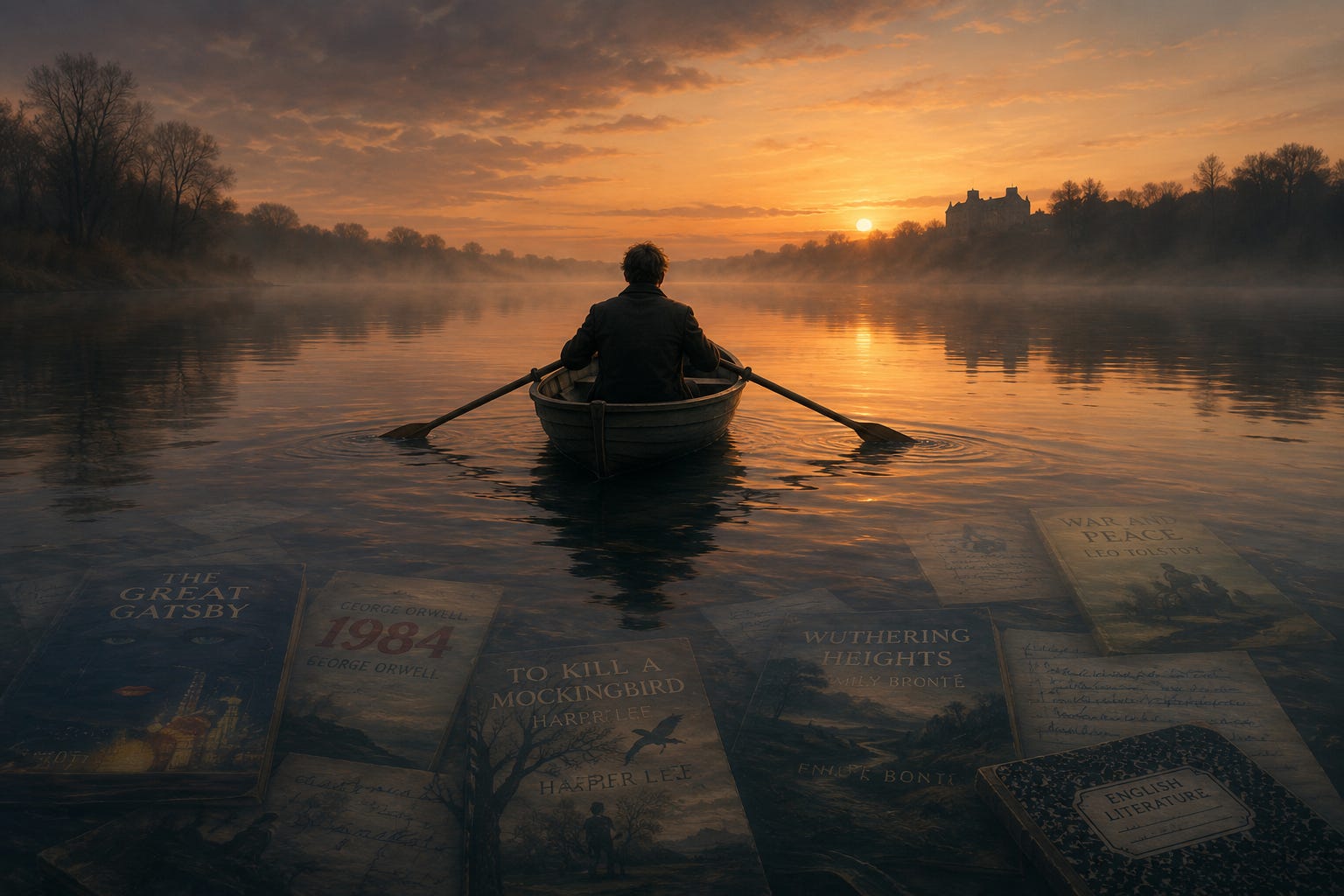
I did it for GCSE and that is one of the themes which emerges from the list. It is full of the sort of books one reads at school - Orwell, Wuthering Heights (absolutely loathed it), To Kill a Mockingbird. (Lord of the Flies is a notable omission). And many of the commentators explicitly note the impact their chosen work had on them at a formative time in their life.
There is a hint of serendipity here. By pure fluke, the world’s finest novel happens to be written in a language the voters studied as teenagers, and their exam boards chose to set it. What are the chances?
That the voters should have taken this approach is understandable. Most people do not read “quality” literature unless forced. As a busy adult, the siren voice of Sally Rooney is more attractive at the end of a hard day than Salman Rushdie’s. I myself have read a grand total of three “good” books since I left university. I’m just not a great fan of great literature (I contrived to leave college after four years of Classics without once cracking open Aeschylus or Sophocles) - it seems a bit too much work most of the time.
Whether or not people do carry on reading good books after school, it is often the last place they actively study them. You may have an inkling that your current reading matter is good, in an English class you get told why it is good and how the author wrote it to be good. Fitzgerald’s use of dust as a motif in Gatsby would have passed me by if I read it as a casual reader, my teacher made sure it didn’t as a student.
Our music tastes appear, at first glance, to work differently. I had no equivalent of Mr Greenhalgh explaining to me why Like a Prayer is a banging pop song. But zooming out slightly, there is a similarity. The music we like is often the music we met as teenagers and young adults, an effect so pronounced that it has been named - the “reminiscence bump”. If we can ascribe the fossilisation of our favourite books to the effort required to acquire new ones, we don’t really have the same excuse with music. It, like love, is all around us. We hear new tunes all the time - on the TV, the radio, in shops, restaurants and, increasingly on public transport when our fellow travellers take it upon themselves to share their playlists. Purely for our education, of course.
And yet it doesn’t seem to stick (my mother’s late onset fondness for Viva La Vida notwithstanding). We keep going back to what we know.
Those who study such things adduce several reasons - we remember the events of our lives between 10 and 30 particularly intently. Teenagers, as anyone who has ever met one will attest, tend to suffer particularly intense emotions. If a book moves you, it will really move you when you’re 15. Adolescents are trying to work out what they think of the world and can latch on to a book which confirms their intuitions (Camus, the Homer of youthful existentialism, features twice). Apprentice adults looking for an identity can find in literature a character who seems like them and who feels like them (Wuthering Heights - absolutely hated it, in case you didn’t pick that up the first time - “changed the fabric of my being at 15” wrote one voter).
These are all perfectly good reasons to like a book. We can understand them. But they don’t really answer the question of which is the greatest novel. They answer a slightly different one - which novel had the greatest impact on you?
Not only is this a different question, it is a different type of question. Choosing the greatest novel requires you to exercise judgement, to sift through the possibilities and use some sort of framework to pick one. Being influenced by a novel is rather more passive. It comes along and changes what is there, or perhaps reveals it. We remember it for what it did to us, not what we did.
I could justify my choice of Gatsby if asked. The portrait of a time and place, the finely honed prose, the artistic use of dust as a motif. But that is all they would be - justifications. The truth is, aged 15 or so, Gatsby was who I wanted to be - glamorous, romantic and, in his acceptance of the blame for the death, faintly noble. I didn’t choose to admire these qualities, they grew out of the world in which I lived - champagne, country clubs and yachts. Had I been in a 1980s pit village, I might have despised him as a criminal agent of the moneyed classes who gets what he deserves.
Perhaps, as Fitzgerald says, we are “borne back ceaselessly into the past”, seeking to recapture a time when possibility seemed limitless, when we still believed we could be what we wanted to be. Or perhaps, though we prefer not to think of it, we are all more acted upon than acting.