
Lumpers and Splitters
A fossil hunter's lesson for a divided world.

One of my numerous personal quirks is that, despite having a degree in Classics, I haven’t read a Classics book for decades. Without being cocky, a four-year degree was more than enough to cover the basics, so any new information acquired, however interesting, would just be infill. Preferring to know a little about a lot, rather than a lot about little, I get the most learning bang for my reading buck by heading to pastures new.
Thus I came across the work of Richard Fortey, a professor at the Natural History Museum who became the popular face of paleontology. A task for which he was well suited. Expert, clear and seemingly possessed of a slightly impish sense of humour (each episode of his series on mass extinctions ends with him eating a descendant of one of the survivors), he is everything you would want in a middle-aged academic.
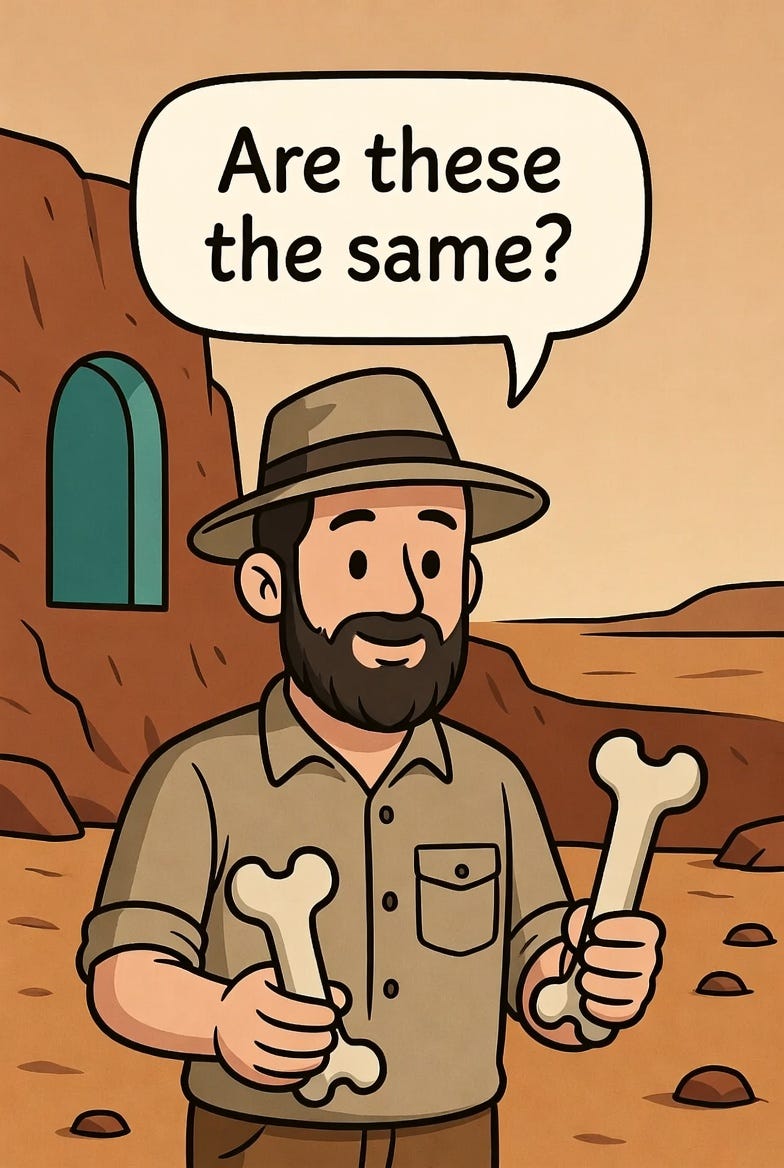
To my shame, it is not his discussion of trilobites or hermit crabs which sticks in my mind, but his description of his colleagues or his taxonomy of taxonomists. When a fossil is discovered, the question immediately arises: What is it? Do you compare it to existing specimens and write off any variation to normal differences between individuals of the same species? Or do you use those differences to argue for the discovery of a new one? Do you lump your discovery in with what we already know, or do you split it off as an entirely new thing?
Applying the insights of evolution to these students of evolution, selection should favour the splitters. Journals are unlikely to publish your paper on the discovery of the 7,000th specimen of a sub-species of ant. They will almost certainly accept you describing an entirely new type of ant. You will get citations, grants, fame, maybe even a TV series. Despite this, “lumpers” exist. There must be something which, even in the cut-throat world of academia, makes it a viable strategy.
The answer, I think, lies outside the dusty realms of academia and inside ourselves. For the lumpers/splitters split [sorry!] describes a fundamental difference in the way people approach the world, and approach life. The former look for points of commonality and overlook points of difference, the latter look for points of difference and overlook points of similarity. Lumpers will look for broad similarities and declare the fit good enough, splitters will see small divergences and declare them fatal.
A lumper who believed fervently in the right to abortion but had been brought up a Catholic might find it possible to identify with the religion while rejecting its teaching on that specific topic because they could bring themselves to overlook that difference of opinion. As long as they believed in Catholic teaching in the round, they could remain Catholic. A splitter would be forced to find a new denomination. Possibly one of which they were the only member.
For the world needs lumpers. Few members of political parties agree with all their positions on all issues. When it comes to choosing, most people take a “close enough” approach. This has its benefits. It allows individuals to co-operate and society to benefit from that cooperation. Individuals gain the advantages of tribal membership. Focusing on what you have in common with others allows you to benefit from their skills in shared projects, gives a sense of community and affords a measure of protection.
With such benefits, it is a surprise that splitters are still around. But they too play a vital function. For sometimes the differences really do matter. A fossilised cat may look broadly similar to a fossilised dog (four legs, spine, rib cage etc.), but the two are radically different things - as anyone who has ever tried to play fetch with a feline knows. Truth often requires us to split things apart.
Seeking commonality can easily drift into passivity, a member staying in a tribe as it drifts ever further from what they truly believe. A need to lump can lead people to claim membership where they don’t really belong, surface similarities trumping deeper disqualifications. If splitting, taken to extreme, can lead to an individual living in an isolated cabin typing screeds about the money supply, too much lumping can lead to a non-player character in a video game - there but not really there.
For most of our history though, lumping was the obvious, almost the only strategy. Life was nasty, brutish and, outside a tribe, very short. Your neighbour’s views on Odin may have been unconventional and possibly offensive, but if you needed his help with the harvest to survive the winter, it was reasonable, even vital, to overlook them.
The modern world, with its globalised, impersonal supply chains removes this logic. Tesco will still sell you food even if it disagrees with your views on transubstantiation. The internet allows ever finer-grained communities. A political party may not share all your policy preferences, but there will be some randos on Reddit who will happily spend all night agreeing with you. The rewards to lumping are not what they were.
Which may explain why we increasingly find it difficult to find consensus. We still look for it, but only among people with whom we know we will find it. Political fragmentation and core vote strategies are artefacts of a world in which splitters are gaining the upper hand.
Or perhaps it would be better to say that the world no longer incentivises us to hide our inner splitter. For few of us are pure. It is a matter of context - in some things, we will insist on scrupulous accuracy, each micro-nuance minutely considered. Others, when we think it to our advantage - either in the real world or the internal world of our identities - we’ll be happy to go with the flow. By reducing the cost of non-conformity, the world is increasing the number of things about which we can split.
There may be greater freedom here, but there is also greater conflict. And, to be blunt, greater effort. If we spend all our time adjudicating ever narrower differences, we will run out of time to do anything else. There is a reason that we may have hills on which we are willing to die, but not mountain ranges. Every so often it is worth asking whether the distinction we think we can see really exists. And whether it’s important enough not to overlook.
I may no longer lump myself in with the Classics crowd. But I haven’t exactly split from them either.